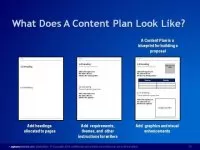
Teaching something truly is the best way to learn it. When I developed the training materials for the MustWin Process, I invented a way to implement Content Planning that I like so much I’ll have to incorporate it into the process during the next change cycle.
The inspiration came from the need to present a Content Plan exercise and break it up into a series of manageable pieces that could fit on slides. Content Plans are supposed to act like a container to hold everything you want to go into the proposal. The problem is that “everything” covers a lot of material. The process provides a checklist, but even that is too long to fit on a slide.
This forced me to group the items on the checklist and put them in sequence. The result reflects the way people naturally work. It is an iterative process. Over a series of steps, the Content Plan evolves into something that anyone can make comprehensive. And the best part is that the steps are in order of priority. If you are working on a proposal with an incredibly short fuse and have to cut corners just to get things done in time, you can skip steps without the process breaking. The opposite is true --- the steps help you maximize the value of the time that you do have.
-
The first iteration creates the container. You take the outline, and allocate it to the correct page count, putting the headings approximately where they should fall in the document. You should do this using the format template of the final document, so that what you end up with is an empty shell document. Into this shell you add instructions to respond to the requirements from your compliance matrix. At this point, your content plan doesn’t have much in it besides what’s in the RFP, but it’s a start. Remember, that what goes into a content plan are placeholders and instructions (single lines or bullets). Not finished narrative. When completed, the content plan provides instructions for the writers and a baseline for reviews. It will turn writing into a process of elimination.
-
In the next iteration, you should add your win strategies, themes, points of emphasis, and instructions for how to optimize the response against the evaluation criteria. This will enable the authors to incorporate them and substantiate them in order to create a proposal that is focused on what it will take to win. If you are following the MustWin Process, you will already have this material prepared, so it’s just a matter of copying it into the Content Plan.
-
In the third iteration, you should insert instructions that identify your offering, or what you are going to propose. In the Content Plan, you should identify the key processes, steps, or components of the solution. You do not need to have all the details worked out --- just enough so that a reviewer can validate that it is the right offering to propose before you commit to writing all the details.
-
For the fourth iteration, you should insert instructions for how to incorporate your customer, opportunity, and competitive intelligence. This is where you tell the writers how to show that your knowledge and understanding exceeds that provided by the RFP. All too often, companies gather intelligence, but somehow it doesn’t make it into the proposal document. Again, if you are following the MustWin Process, you already have this information in the right format to easily use.
-
The fifth iteration is about considering the many ways to improve your visual communications. These include enhancements like features/benefits tables, navigation and scoring aids, tables and lists, RFP relevance boxes, examples, graphics ,etc. Add empty tables, placeholders for graphics, blank boxes, etc., with instructions for how the writers should complete them.
-
The sixth and final iteration is about identifying any assumptions, limitations, boundaries, or issues that must be resolved. These are often necessary to deal with ambiguities or flaws in the RFP. List the ones that you know about, to provide guidance to your writers. Also include instructions for the authors to capture any that they discover during the process of writing.
At this point, your Content Plan should reflect everything that needs to go into your proposal. You have a comprehensive blue print, that if followed, will produce the right proposal. And once your Content Plan is validated, your reviewers can use it to check the draft narrative, when it is complete, to ensure that the final document addresses everything that it should have. If you are unable to get to the sixth, fifth, or even the fourth iteration, you should still have a superior foundation and instructions that can be followed to write a winning proposal. If all you do is the first iteration, you will still have the foundation for creating a compliant proposal.

By Carl Dickson, Founder of CapturePlanning.com and PropLIBRARY